To minimise the risk of fire spreading from one floor to another via openings in external walls in buildings of Type A construction.
C3D7 Vertical separation of openings in external walls
Buildings of Type A construction
C3D7 generally applies to buildings of Type A construction and Class 9a buildings of Type B construction, because they are the only buildings required to provide fire separation between floors. This separation is achieved by the floor being required to have a fire-resistance level (FRL). It applies to openings above one another in different storeys if they are within a horizontal distance of 450 mm of each other.
It does not apply to:
- sprinkler protected buildings because the sprinklers should prevent the fire developing to the stage where it could spread to the floor above;
- openings in a fire-isolated stairshaft. This is because the stair shaft is not considered to be separate storeys and it is assumed that fire spread between floors will not occur via the stairway; or
- open-deck carparks and open spectator stands. This is because it is unlikely that fire would spread between floors in these types of buildings as their open construction allows the dissipation of the effects of fire.
In addition, Class 9a buildings of Type B construction require openings in external walls to be vertically separated in accordance with C3D7 as if the building was Type A construction (see C3D6(1)(d)). This can be achieved either by the construction methods outlined below or the installation of sprinklers in the building. The reason for this is that it is important to inhibit the spread of fire between floors in Class 9a buildings.
Protection of vertically separatedopenings
C3D7 requires the vertical separation of openings in external walls (see C3D7(1) and (2)) of buildings of Type A construction which do not have a sprinkler system complying with Specification 17 (other than a FPAA101D or FPAA101H system). The vertical separation of openings can be achieved by either of the following methods:
- a non-combustible spandrel or other non-combustible vertical construction having an overall height of 900 mm or more, extending at least 600 mm or more above the upper surface of the intervening floor, and having an FRL of 60/60/60 (see C3D7(1)(a)) as shown in Figure C3D7a; or
- a non-combustible horizontal projection having an outwards projection from the external face of the wall of 1 100 mm or more, an extension along the wall beyond the openings of at least 450 mm, and having an FRL of 60/60/60 (see C3D7(1)(d)) as shown in Figure C3D7b).
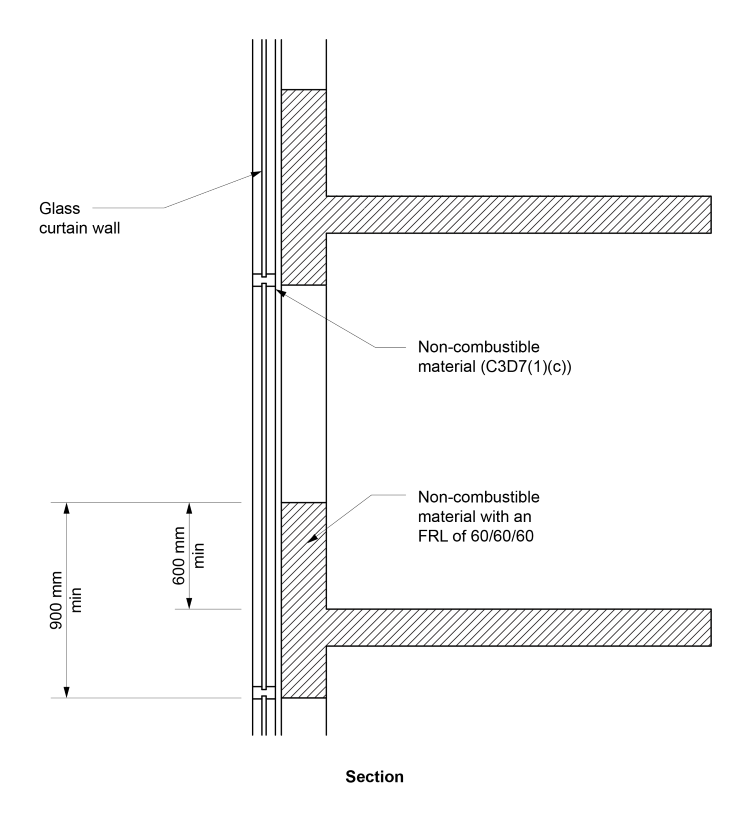
If the external wall of the building is a glass curtain wall, C3D7(1)(c)contains specific provisions to stop or limit the spread of fire and smoke between the glass and the edge of the concrete floor. The details are shown in Figure C3D7c.
Although it could be argued that the spandrel or vertical projection should have the same FRL as the floor separating the storeys, this has not been found to be necessary.
Meaning of “window or other opening”
C3D7(3) explains the meaning of the term “window or other opening” as used in C3D7(1). Basically, the term is used to describe a part of the external wall which does not have an FRL of at least 60/60/60 to limit the spread of fire from one storey to another by passing out through the window or opening and then re-entering the building through a similar opening (i.e. one without an FRL of at least 60/60/60) on the storey above. Examples of such openings include:
- windows;
- glass curtain walls;
- non-fire rated panels; and
- other partsof the wall that do not have an FRL of at least 60/60/60.
Figure C3D7a: Section showing use of spandrel to separate external window openings
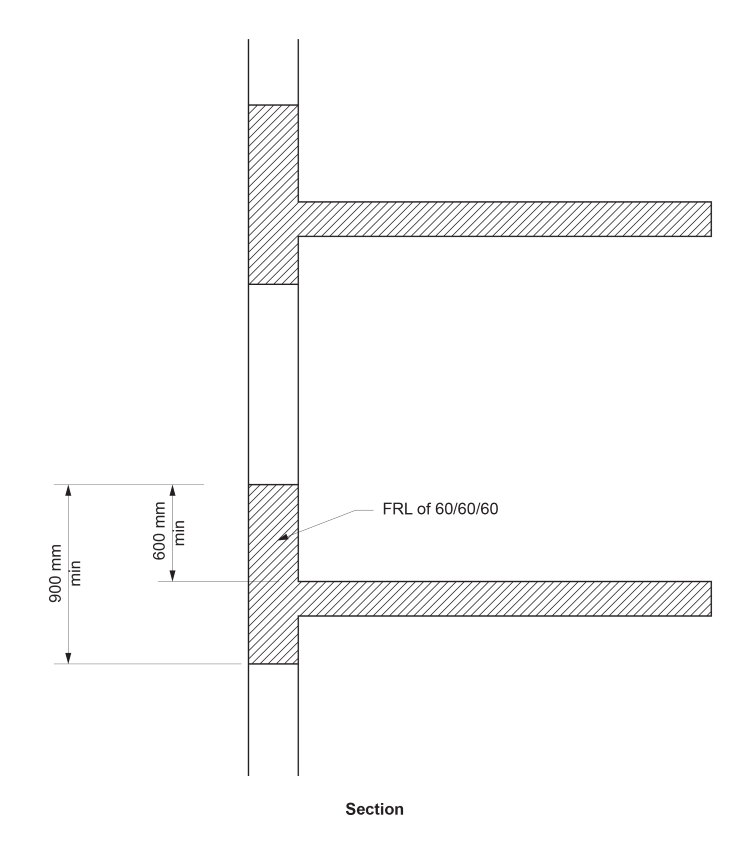
Figure C3D7b: Example showing use of slab or horizontal construction to separate external window openings
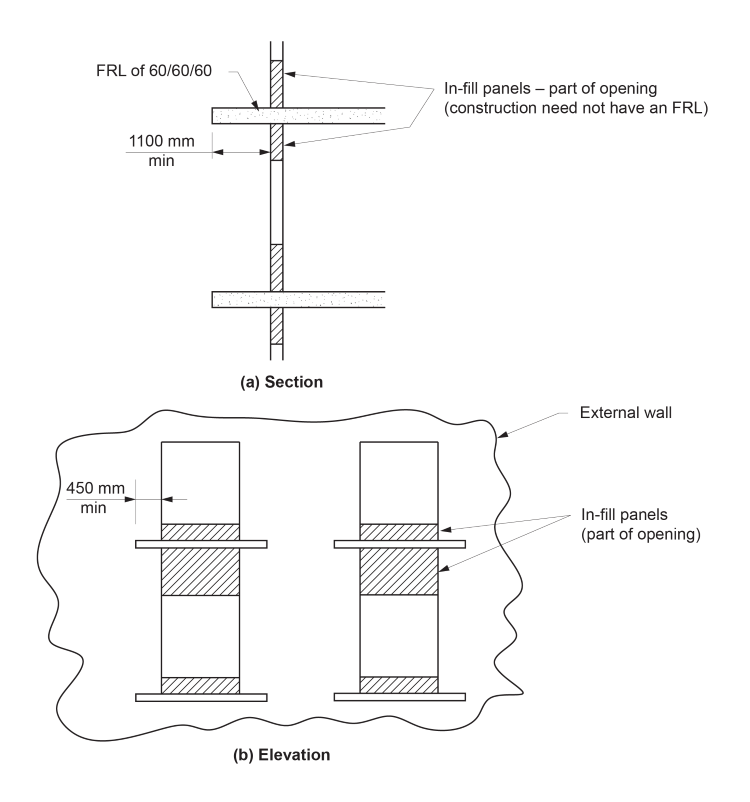
Figure C3D7c: Section showing separation of external window openings in a curtain wall