To provide occupants using a horizontal exit with the same protection as those using a fire-isolated exit.
C4D8 Protection of doorways in horizontal exits
Type of doors permissible
The use of fire shutters are prohibited in a horizontal exit by D3D24(2)(b). Similarly, D3D24(2)(c) does not permit sliding doors to be used as horizontal exits.
There are some concessions to these prohibitions (see D3D24).
The fire doors used for horizontal exits, as referred to in C4D8, must swing in the direction of travel (as required by D3D25).
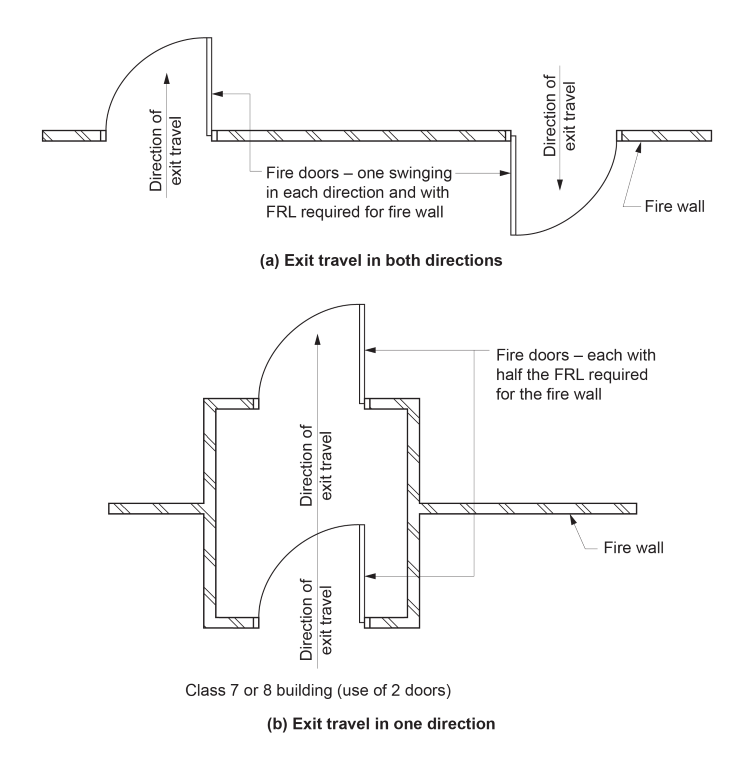
If the horizontal exit applies in both directions (i.e. the doorway may be used to escape from either fire compartment to the other), the installation of two doors may be necessary (see Figure C4D8).
Buildings other than Class 7 and 8
Unless it is located in a Class 7 or Class 8 building, a doorway which is part of a horizontal exit must be protected by a single fire door complying with C4D8(1)(a).
Two fire doors in Class 7 and 8
The reason for allowing two fire doors to be installed in a doorway in Class 7 and Class 8 buildings is because single fire doors with the required fire-resistance level (FRL) are heavy and difficult to open. In combination, the two fire doors must achieve an equivalent FRL to the fire wall.
If two fire doors are installed in a doorway in a Class 7 or Class 8 building, it may be necessary to install a small lobby to allow for the swing of the doors (see Figure C4D8).
C4D8(2) has the same requirements for fire doors as C4D6 Refer to the comments made in C4D6 for application to C4D8(1).
Figure C4D8: Plans showing horizontal exits in a fire wall