To enable the safe movement of people using stairways.
Background to D3D14—goings and risers
The going and riser requirements in D3D14 date from a substantial reform carried out in 1987, based on international research.
No more than 18 nor less than 2 risers—D3D14(1)(a)
D3D14(1)(a) states that a stairway must have no more than 18 nor less than 2 risers in each flight. Where there are less than 2 risers in a flight, they do not comprise a stairway for the purposes of the NCC.
Eighteen risers is considered to be the maximum reasonable number that an average person can negotiate before requiring a rest.
Winders are counted as part of the maximum number of 18 risers. More than one riser is considered necessary for a person to observe and adjust to a change in level.
Going and riser dimensions—D3D14(1)(b) and (c) and (2)(b) and (c)
The purpose of D3D14(1)(b) and (c) and (2)(b) and (c) is to achieve constant going and riser dimensions deemed safe for people to walk up and down. This minimises the risk of people overstepping during descent on uneven stairs (due to short goings) and tripping on ascent (due to high risers). Table D3D14 expresses ratios between goings and risers which are considered safe for use.
D3D14(1)(c) and (2)(b) accounts for conditions such as movement of materials due to atmospheric moisture changes or minor deviations related to variations in materials which affect finished stair dimensions.
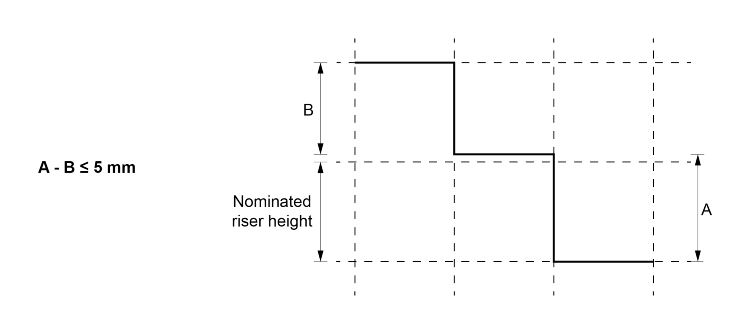
Figure D3D14a in this Guide illustrates adjacent risers within a flight with minor deviations in the materials affecting the finished stair dimensions. The nominated riser height is exceeded by riser A. As a consequence riser height B is less than the nominated riser height. The difference between riser A and riser B cannot exceed 5 mm.
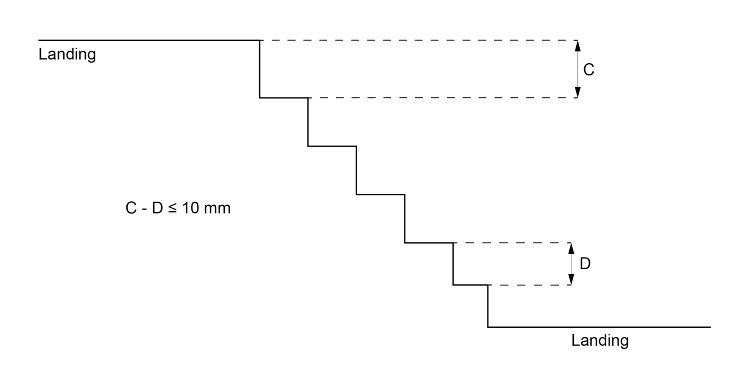
Figure D3D14b in this Guide illustrates an entire flight with minor deviations in the materials affecting the finished riser dimensions. In addition to the 5 mm difference permitted between adjacent goings or risers, the maximum difference between the smallest and largest going or riser within a flight must not exceed 10 mm.
Despite the deviations shown in both Figure D3D14a and Figure D3D14b, the stairs in the flight are deemed constant.
Irrespective of any minor deviations permitted by D3D14(1)(c) and (2)(b), finished going and riser dimensions must not exceed the limitations stipulated in Table D3D14.
Openings in stair risers—D3D14(1)(d)
D3D14(1)(d) allows the use of open stair risers. However, it limits the opening to 125 mm to minimise the risk to children.
Treads—D3D14(1)(e)
Under D3D14(1)(e), treads must have a surface or nosing strip which prevents people slipping over and injuring themselves.
In each case the surface or nosing strip must have a slip-resistance classification when tested in accordance with AS 4586. Similar to D3D11(3) there are two tests (the wet pendulum test or the oil-wet inclining platform test) and two conditions (dry or wet) to be considered.
Solid treads—D3D14(1)(f)
Under D3D14(1)(f), where a stairway is of a specified height, solid treads must be used so that people cannot see through them. This minimises the risk to people affected by vertigo.
Change in direction—D3D14(1)(g)
Under D3D14(1)(g), stairways in Class 9b buildings require a change in direction of at least 30° at specified points. This limits the distance a person can trip or fall down the stairways. This sort of occurrence is more likely to take place in buildings with large numbers of people who are unfamiliar with the building or its stairways.
Winders in lieu of landings—D3D14(1)(h) and (2)(a)
Under D3D14(1)(h), winders in lieu of landings are not permitted in a required stairway. Under D3D14(2)(a) winders in lieu of landings are permitted in non-required stairways provided that not more than 3 winders in lieu of a quarter landing or not more than 6 winders in lieu of a half landing are used.
Sloping public walkways — D3D14(3)
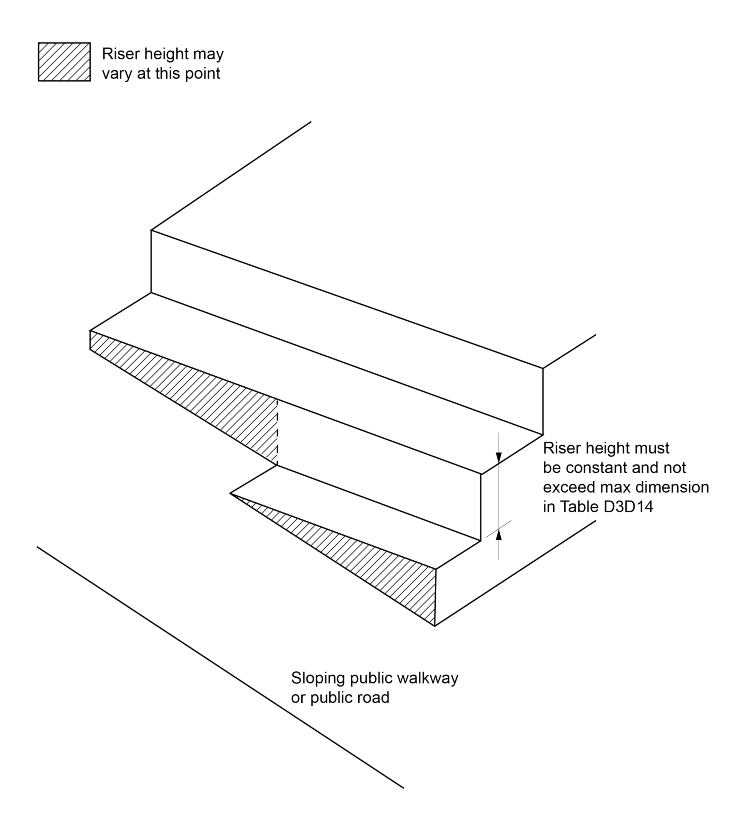
When a stairway discharges directly to a sloping public walkway or road, it is extremely difficult to maintain a constant riser height without setting the stairway back from the walkway. D3D14(3) therefore allows a variation in the riser height in these situations.
See Figure D3D14c in this Guide.
Table D3D14
Table D3D14 addresses both public and private stairways, and provides information on acceptable maximum and minimum risers and goings. It also illustrates the method of measuring the rise and going of stairway treads and the maximum gap between treads referred to in D3D14(1)(d).
Note 2 of Table D3D14 allows the use of a stairway which is curved, or circular in plan view.
Figure D3D14a: Deviations in adjacent risers
Notes:
1. A = larger riser of two adjacent risers.
2. B = smaller riser of two adjacent risers.
3. This figure only shows deviations in risers, however the same principle can apply for goings
Figure D3D14b: Deviations over a flight
Notes:
1. C = largest riser of the flight.
2. D = smallest riser of the flight.
3. This diagram only shows deviations in risers, however the same principle can apply for goings.
Figure D3D14c: Stairway for sloping public walkway or road