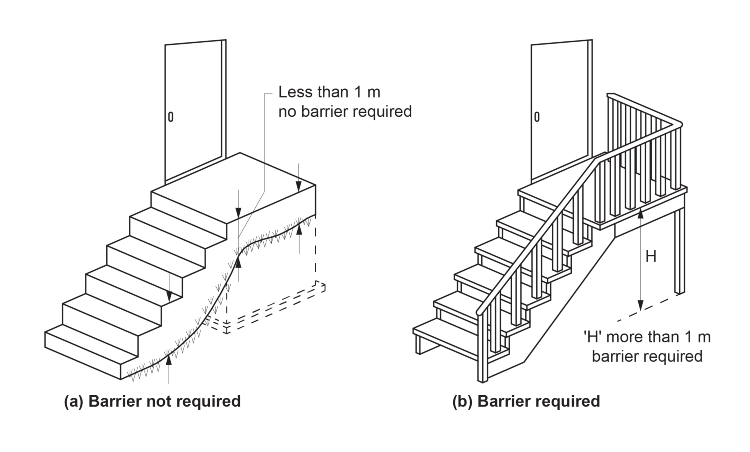
To minimise the risk of a person falling from a roof, stairway, raised floor level or the like.
Whether floor is a landing or a ramp—D3D18(1)(a) and (b)
The slope of 1:20 is included to distinguish between the floor of a ramp and the floor of a landing that has a slight slope for drainage purposes. The result is that if the floor has a slope of less than 1:20, it is considered as a landing and must have a barrier with a height of not less than 1 m above the floor. In all other cases, the floor is considered to be a ramp, where the barrier must have a height of not less than 865 mm above the floor.
Certain Class 9b buildings—D3D18(1)(c)
For certain Class 9b buildings, lesser heights are permitted to allow uninterrupted viewing of a performance. These lower heights are not expected to be a problem, because unaccompanied children are unlikely to be present.
Measurement of barrier height—D3D18(2)(a)
When measuring the height of the barrier, allowance should be made for floor finishes such as tiles and carpet when they are to be installed at a later time.
Transition zones—D3D18(2)(b)
A transition zone is permitted where the barrier above the stair nosings and landing meet. This overcomes the need for a step in the top of the barrier to maintain the 1 m height above the landing. See Figure D3D18b.
Figures D3D18a and D3D18b illustrate the various requirements for barriers.
Figure D3D18a: Illustration of barrier heights and spacings
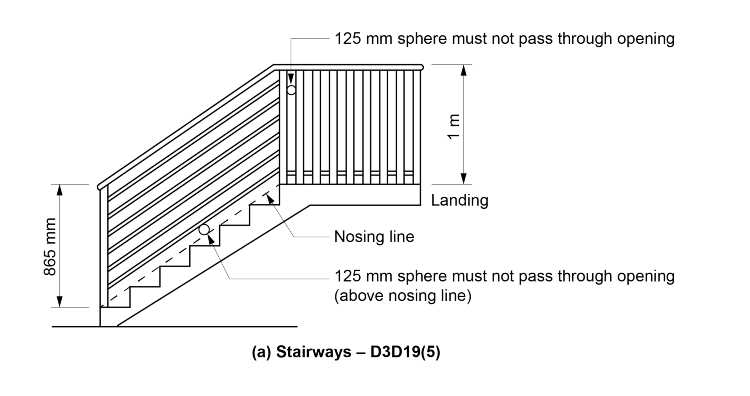
Figure D3D18b: Illustration showing when barriers are required