To minimise the risk that a person becomes trapped in a fire-isolated exit.
Facilitate entry to another exit route
It is not unknown for a fire-isolated exit to become unusable during an emergency. In high-rise buildings, hospitals and Class 9c buildings people must be able to leave the exit and proceed to an alternative exit to evacuate. It is unlikely that the second exit will also be unusable.
One option is for a person in a fire-isolated stairway to enter a storey and gain access to the alternative exit through that storey.
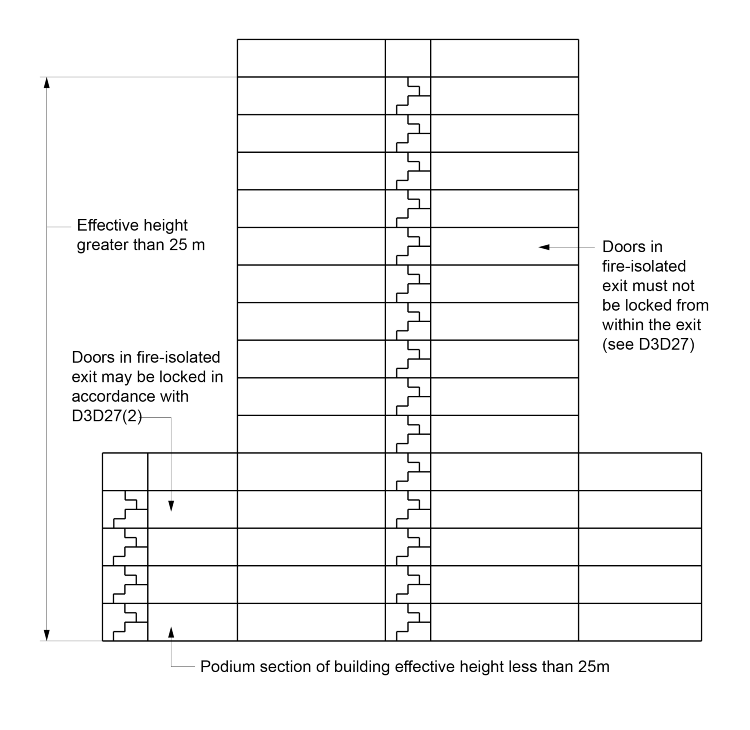
D3D27(1)(d) applies to the whole fire-isolated exit serving a storey above an effective height of 25 m. This means that a fire-isolated exit serving a storey below an effective height in a building with an effective height 25 m or greater, is treated the same as one in a building with an effective height of less than 25 m, provided it does not also serve a storey that is located above an effective height of 25 m.
It should be noted that if a fire-isolated passageway serves two stairways, one of which serves a storey above an effective height of 25 m, then D3D27(1)(d) will apply, i.e. the doors cannot be locked from the inside.
The requirements of D3D27(1)(b) do not apply to a door fitted with a fail-safe device that automatically unlocks the door serving the Class 9b early childhood centre upon the activation of a fire alarm.
Examples
Consider a building consisting of a 5 storey podium and a main tower with an effective height greater than 25 m. Any fire-isolated stairway and associated fire-isolated passageway serving the tower must not have doors locked from within the exit. However, because the storeys in the podium are below an effective height greater than 25 m, any fire-isolated stairway and associated fire-isolated passageway that only serves those storeys may have a door locked from within the exit.
See Figure D3D27.
Mistaken entry
Under normal conditions of use, it is also possible that a person may mistakenly enter a fire-isolated exit. That person should not be required to travel all the way down the stairway to be able to leave it, especially in a high-rise or Class 9c building.
Every fourth storey re-entry
The ability to enter at each floor of a building could be unnecessary and lead to a breach of a building’s security. Accordingly, entry at every fourth floor (under D3D27(2)(a)) will achieve the intent of this provision, without significantly interfering with the building’s security. Where this option is taken, all doors must be openable by a fail-safe device activated by a fire alarm.
Intercommunication systems
An alternative method of minimising the risk of a person being trapped in a fire-isolated stairway is to provide an intercommunication system under D3D27(2)(b). Where this option is taken, all doors must be openable by a fail-safe device activated by a fire alarm.
Figure D3D27: Illustration of exits serving storeys above and below an effective height of 25 m