To specify the minimum acceptable sanitary, bathing, laundry and cooking facilities required in Class 3 buildings (for employees only) and in Class 5-9 buildings.
F4D4 Facilities in Class 3 to 9 buildings
F4D4 and Tables F4D4a to F4D4l contain the requirements for the type and number of facilities required. They are based on the premise that a higher ratio of sanitary facilities is required in buildings where occupants spend a long time.
Examples
A higher ratio of sanitary facilities is required in a Class 7 or Class 8 workplace (where employees could spend all day) than in a Class 6 department store (where customers could be expected to spend less time).
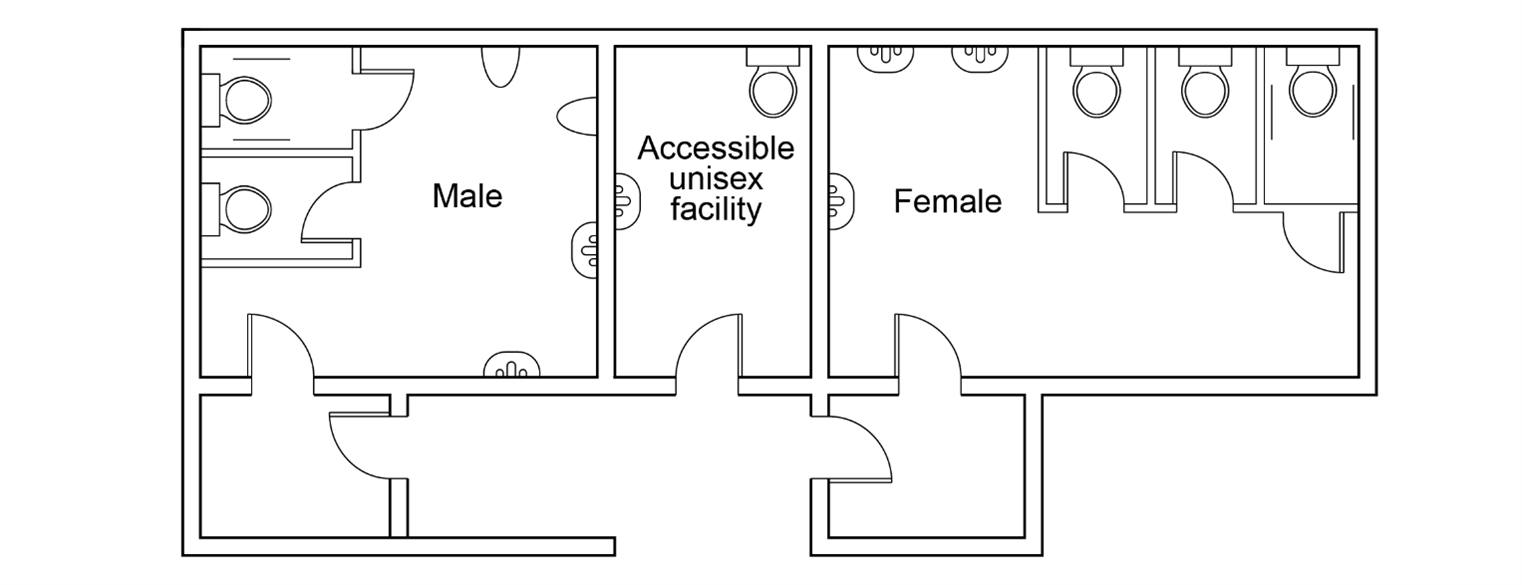
F4D4(1) requires the separation of male and female toilets. F4D4(3), (4) and (7) provide specific exemptions permitting unisex and combined facilities in some circumstances. Figure F4D4 [RM1] shows an example of a typical layout that meets the requirement for separate facilities under F4D4(1).
Table F4D4: Example of a typical layout for separate facilities
Except in schools and early-childhood centres, separation of facilities for employee and the public is not required (see F4D4(5)). Separation is required in schools to maintain the teacher/student relationship, while in early childhood centres it is required because of the:
- provision of junior pans;
- use of the facilities for hygiene training purposes; and
- need to keep the children under observation.
Sanitary facilities for females must be provided with a means of disposal of sanitary products (see F4D4(6)). This might include an incinerator, or a bin and disposal service. This provision also applies to unisex or male/female shared facilities permitted by F4D4(3) and (4).
F4D4(7) provides an exemption to (1) for ward areas in a Class 9a building. This allows for unisex facilities for operational requirements such as flexible bed allocations.
For health-care buildings—in addition to Table F4D4e, F4D4(8) requires facilities for preparing meals and laundering to meet the needs of patients and occupants residing in the building.
F4D4(8)(a) therefore requires:
- a kitchen or other facilities for the preparation and cooking or reheating of food;
- a kitchen sink for the washing of plates, cutlery,cooking utensils, and the like; and
- a washbasin for kitchen staff to wash their hands.
Because of the amount of linen and clothes requiring laundering in these buildings, F4D4(8)(b) requires laundry facilities; or places for the holding and dispatching soiled linen, clothing, and the like; and the receipt and storage of clean linen.
For early childhood centres—F4D4(9)(a) requires a kitchen because young children may require food prepared on the premises, possibly in the form of special diets. The kitchen must comprise:
- facilities for the preparation and cooking of food for infants;
- a kitchen sink;
- separate hand washing facilities;
- space for a refrigerator and;
- child proof latches attached to any access door or gate to the kitchen facilities to prevent unsupervised entry to the kitchen by children younger than 5 years.
F4D4(9)(a) requires, if the centre accommodates children younger than 2 years, the kitchen to be designed and constructed to facilitate supervision of children in the centre. In some circumstances, such as in a large early childhood centre, supervision requirements may not be fully achievable. In these situations a Performance Solution may be required. For example, the solution may provide an option to be able to supervise the activities of children younger than 2 years while also engaging in the heating of baby bottles, an option which may not be possible with the main kitchen.
If the building accommodates children younger than 3 years, there may also be a need to carry out washing of nappies and other clothing. F4D4(9)(c)(i) therefore requires the installation of laundry facilities (but not drying facilities) in these buildings comprising:
- a washtub; and
- space in the same room for a washing machine.
Other requirements for centres accommodating children younger than 3 years are also prescribed under F4D4(9)(c)(ii) and (iii).
F4D4(9)(c)(ii) requires a bench-type bath to be provided within 1 m of a nappy changing bench.
F4D4(9)(iii) specifies the requirements for a nappy changing bench. The requirements in (A) to (D) require the nappy changing bench to be:
- within 1 m of a separate adult hand washing facility;
- not less than 0.9 m2 in surface area for the top of the bench;
- not less than 850 mm and not more than 900 mm from the finished floor level to the top of the bench. This height range is specified for ergonomic and safety reasons;
- provided with a space not less than 800 mm high x 800 mm deep x 500 mm wide for the storage of steps; and
- provided in a location so that the play area is visible at all times, to allow adequate supervision of other children whilst changing a child.
Examples
A Class 6 department store has a total floor area of 2000 m2. From information provided by the proponent for the development, 35 staff will be employed. The sales floor has an area of 1700 m2. Applying F4D3(1) and Table D2D18, the number of customers that could be expected to be accommodated is 567 persons (one customer for each 3 m2 of sales floor area). Applying F4D3(2), an equal 50/50 gender ratio for both staff and customers is used.
The total number of persons accommodated is 602 (567+35). The number of facilities required by Table F4D4c is set out below in example Table F4D4.
Table F4D4: Calculation of number of sanitary facilities—Class 6 department store
| User group | Design occupancy | Number of closet pans | Number of urinals | Number of wash- basins |
| Male employees | 17.5 | 1 | 1 | 1 |
| User group | Design occupancy | Number of closet pans | Number of urinals | Number of wash- basins |
| Female employees | 17.5 | 2 | - | 1 |
| Total employees | 35 | 3 | 1 | 2 |
| Male patrons | 283.5 | 1 | 1 | 1 |
| Female patrons | 283.5 | 1 | - | 1 |
| Total patrons | 567 | 2 | 1 | 2 |
| Overall total | 602 | 5 | 2 | 4 |
Table Notes
The overall total number of closet pans and wash basins can be reduced by one for each sex where a unisex facility for people with a disability is provided (see F4D3(3)). The BCA does not require facilities for staff to be in an area separate from customers. Therefore a single toilet block with separate male and female facilities could be provided (see F4D3(4)) but a separation may be needed under some other regulations, such as workplace or health regulations, so should be checked.
In addition to F4D4, Work Health and Safety legislation may require supplementary facilities. This can include showers and change rooms in some work places, depending on the natureof the work and workingconditions of the employees.