To allow natural light to be “borrowed” from an adjoining room.
F6D4 Natural light borrowed from adjoining room
F6D4 applies only to a room in:
- a Class 2 building;
- a Class 4 part; or
- a sole-occupancy unit in a Class 3 building.
For these Classes, it is sometimes acceptable for a room’s required natural light to be “borrowed” from an ad joining room (i.e. an adjoining room’s light can be used to help make up the total amount of natural light required in the subject room).
The use of borrowed light is acceptable if the provisions of F6D4 are applied to the subject room and to the total area of each relevant room.
Any borrowed natural light must be from an adjoining room over which occupants of the subject room have some control. F6D4(1)(a) therefore requires that the adjoining room be within the same sole-occupancy unit or be an enclosed verandah on common property. As a consequence, the required natural light cannot be from another sole-occupancy unit.
Direct natural light provided from another source is intended to mean light from a window or roof light in the subject room. As the provision relates to natural light obtained from an adjoining room, ‘another source’ refers to direct natural light provided to the subject room which does not meet the required allowance of either 3% or 10% of the floor area for roof lights and windows respectively. By not meeting the required amount of natural light, the ‘direct natural light from another source’ can be used as a supplement to the natural light required from an adjoining room.
To borrow natural light from another room, F6D4(1)(b) allows light to pass through glazed panels or openings from an adjoining room which, under F6D4(1)(c), must have windows, roof lights or a combination of windows and roof lights of a minimum size in proportion to the combined floor areas of both rooms. The minimum size of the glazed panels or openings, and the minimum size of the windows to the adjoining room, are illustrated in Figure F6D4.
If a doorway is used as an opening to obtain light from an adjoining room, any door is required to transmit natural light directly from outside a building to the room concerned when in the closed position (see Figure F6D4).
The area of openings needed to transmit natural light from an adjoining room may be reduced proportionally to the size of any openings in the subject room which transmit natural light directly from the outside.
Figure F6D4: Method for determining areas of openings for borrowed light
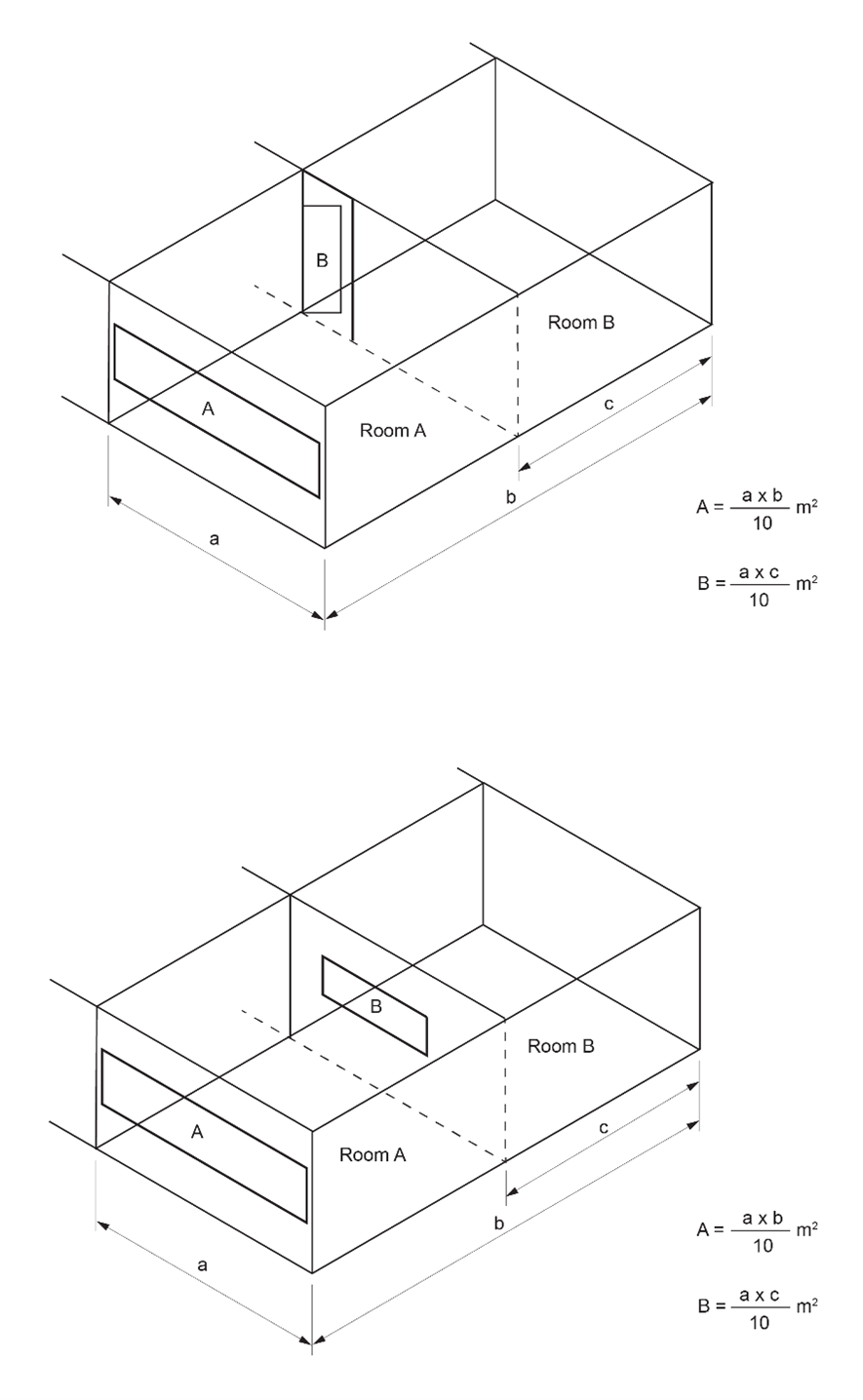
The same principle for Opening A in Figure F6D4 can be applied for roof lights by substituting the required 10% opening in respect to the combined floor area with 3% of the combined floor area. It is also permitted to use a proportional combination of windows and roof lights. See the example in the comments on F6D3 for an explanation.