(1) Where required, insulation must comply with AS/NZS 4859.1 and be installed so that it—
abuts or overlaps adjoining insulation other than at supporting members such as studs, noggings, joists and the like where the insulation must butt against the member; and
forms a continuous barrier with ceilings, walls, bulkheads, floors or the like that inherently contribute to the thermal barrier; and
does not affect the safe or effective operation of a domestic service or fitting.
(1) A roof must achieve the Total R-Value of 2.7 for the downwards direction of heat flow in climate zone 1 and downwards and upwards in climate zone 3.
(2) The Total R-Value is reduced to 2.2 for each of the following:
The roof upper surface has a solar absorptance value of not more than 0.55.
The roof space is ventilated by—
gable vents, ridge vents, eave vents, roof vents or the like that—
are evenly distributed to allow an unobstructed flow of air; and
are located to ensure, where practicable, there are no dead airspaces; and
have an aggregate fixed open area of not less than 1.0% of the ceiling area; or
not less than 2 wind-driven roof ventilators having an aggregate opening area of not less than 0.14 m2 in conjunction with gable vents, ridge vents, eave vents, roof vents or the like having an aggregate fixed open area of not less than 0.2% of the ceiling area; or
has metal sheet roofing fixed to metal purlins, metal rafters or metal battens; and
does not have a ceiling lining or has a ceiling lining fixed directly to those metal purlins, metal rafters or metal battens,
must have a thermal break, consisting of a material with an R-Value of not less than 0.2, installed between the metal sheet roofing and its supporting member.
(5) Where, for operational or safety reasons, ceiling insulation cannot be installed at or around exhaust fans or recessed downlights, a reduction of insulation of 1% or more of the ceiling area must be compensated for by proportionately increasing the R-Value of insulation in the remainder of the ceiling in accordance with Table NT 13.2.3d.
Insert NT table (13.2.3a) 13.2.3 as follows:
NT Table 13.2.3a: Typical insulation options for typical roof and ceiling construction: Unventilated roof spaces
The roof space ventilation option applies to a pitched roof with a flat ceiling to ensure that efficient cross ventilation is achieved in the roof space to remove hot air. Roof space ventilation is generally not suitable for most flat, skillion, cathedral ceiling and similar roof types because of the lack of space between the ceiling and roof.
Care should be taken to ensure that the roof ventilation openings do not allow rain penetration and that they comply with appropriate bushfire provisions.
Gaps between roof tiles with sarking (or reflective insulation at rafter level) and metal sheet roofing are not acceptable methods of providing roof space ventilation.
Compliance with the ventilation provisions may result in the ingress of wind driven rain or fine dust, or stimulate the growth of mould or fungus in the roof enclosure. Consideration should therefore be given to the surrounding environmental features prior to adopting this as an alternative to the roof insulation provisions.
A light coloured roof reduces the flow of heat from solar radiation better than a dark colour roof. A roof with a solar absorptance value of less than 0.55 means the roof is of a light colour such as white, off-white, cream or dull zinc aluminium.
Explanatory information: Tables NT 13.2.3a, NT 13.2.3b and NT 13.2.3c
Typical construction: The tables above provide examples of various roofs and ceiling, walls and floors. The Total R-Valuerequired is achieved by adding the Total R-Value of the basic element, i.e. roof and ceiling, walls or floors, and the R-Value of any additional insulation incorporated in that element The Total R-Value of the basic roof and ceiling has been determined by adding together the R-Values of the outdoor air film, roof cladding, roof airspace, ceiling sheet lining and internal film.
The Total R-Value of the roof and ceiling materials may need to be adjusted if other building elements such as sarking are also installed. For example, sarking or sheet insulation under tiles may change a roof space from “ventilated” to “unventilated”.
Thermal bridging: Irrespective of the framing material used, the minimum added R-Value specified is deemed to include the effect of thermal bridging created by framing members in situations other than described in the following point.
Thermal break: Because of the high thermal conductance of metal, a thermal break is to be provided where the ceiling lining of a house is fixed directly to the underside of the metal purlins or metal battens of a metal deck roof or where there is no ceiling lining. The purpose of the thermal break is to ensure that the thermal performance of this form of roof construction is comparable to that of a similar roof with timber purlins or timber battens. A thermal break may be provided by materials such as timber, expanded polystyrene strips, plywood or compressed bulk insulation. The material used as a thermal break must separate the metal purlins or metal battens from the metal deck roofing and achieve the specified R-Value. Reflective insulation alone is not suitable for use as a thermal break because it requires an adjoining airspace to achieve the specified R-Value (see last point).
Location of insulation: The thermal performance of the roof may vary depending on the position of the insulation, the climatic conditions, the design of the house and the way in which it is operated. For example, insulation installed under the roof, rather than on the ceiling, of a conditioned house with a large roof space is less effective because of the additional volume of roof air space that would need to be heated or cooled. Conversely, for an unconditioned house, the use of reflective insulation is more effective when placed directly under the roof.
Choice of insulation: There are a number of different insulation products that may be used to achieve the minimum added R-Value. However, care should be taken to ensure that the choice made is appropriate for the construction and climatic conditions as the location and relationship other building elements may not be suitable in all circumstances for both practical and technical reasons. For instance, in some climate zones, insulation should be installed with due consideration of condensation and associated interaction with adjoining building materials. Reflective insulation and its adjoining airspace is considered to achieve the following R-Values when used in conjunction with the Total R-Value of a pitched roof and flat ceiling construction. To achieve these values, the reflective insulation must be laid directly under the roof cladding and have a minimum airspace of 15 mm between a reflective side of the reflective insulation and the adjoining lining or roof cladding. The actual R-Value added by reflective insulation and its adjoining airspace should be determined for each product which takes into consideration factors such as the number of adjacent airspaces dimensions of the adjacent airspace, whether the space is ventilated and the presence of an anti-glare coating. When reflective insulation has an anti-glare coating on one side, the emittance value of that side will be greater than the value of the uncoated side. Also, where another emittance value for reflective insulation is used (other than the value used in NT Table 13.2.3d), care should be taken to ensure that the number of airspaces allowed for is consistent with the form of construction and whether the airspace is reflective, partially reflective or non-reflective. Where bulk insulation fills the airspace, the Total R-Value should be reduced to take account of the loss of airspace.
Explanatory information: 13.2.3(5) and Table NT 13.2.3d
When considering the reduction of insulation because of exhaust fans and recessed downlights, 1% of the ceiling area for a 200 m2 sized house would permit 2 bathroom heater-light assemblies, a laundry exhaust fan, a kitchen exhaust fan and either approximately 25 recessed downlights with 100 mm clearance to the insulation or approximately 10 recessed downlights with 200 mm clearance to the insulation.
NCC Title
Roofs
NCC State
NT
NCC SPTC Current
Roofs
NCC ID
_06f1ec8b-a1e6-43ec-95ec-1aeab058b060
NCC Blurbs
Roof lights serving a habitable room or an interconnecting space such as a corridor, hallway, stairway or the like—
if the total area of the roof lights is more than 1.5% but not more than 10% of the floor area of the room or space, must comply with Table NT 13.2.4; or
if the total area of the roof lights is more than 10% of the floor area of the room or space they serve, may only be used where—
compliance with the natural lighting requirements can only be achieved by a roof light; and
the transparent and translucent elements of the roof lights, imperforate ceiling diffuser, achieve— including any
an SHGC of not more than 0.25; and
a Total U-Value of not more than 1.3; and
The aggregate area of roof lights serving a building must not exceed 3% of the total area of the floor of the storey served.
Insert NT table (13.2.4) 13.2.4 as follows:
NT Table 13.2.4: Roof lights – thermal performance of transparent and translucent elements
SHGC of not more than 0.5 and a Total U-Value of not more than 5.0
SHGC of not more than 0.25 and a Total U-Value of not more than 2.5
1.0 to 2.5
Total U-Value of not more than 5.0
SHGC of not more than 0.25 and a Total U-Value of not more than 2.5
2.5 and above
Total U-Value of not more than 5.0
SHGC of not more than 0.25 and a Total U-Value of not more than 2.5
Table Notes
The roof light shaft index is determined by measuring the distance from the centre of the shaft at the roof to the centre of the shaft at the ceiling level and dividing it by the average internal dimension of the shaft opening at the ceiling level (or the diameter for a circular shaft) in the same units of measurement.
The total area of roof lights is the combined area for all roof lights serving the room or space.
The area of a roof light is the area of the roof opening that allows light to enter the building.
The thermal performance of an imperforate ceiling diffuser may be included in the Total U-Value of the roof light.
NCC Title
Roof lights
NCC State
NT
NCC SPTC Current
Roof lights
NCC ID
_70757d9f-ab95-4976-80a8-375d4eef55da
NCC Blurbs
A Class 10a building attached to a Class 1 building must—
have an external fabric that achieves the required level of thermal performance for a Class 1 building; or
be separated from the Class 1 building with construction having the required level of thermal performance for the Class 1 building.
Explanatory information
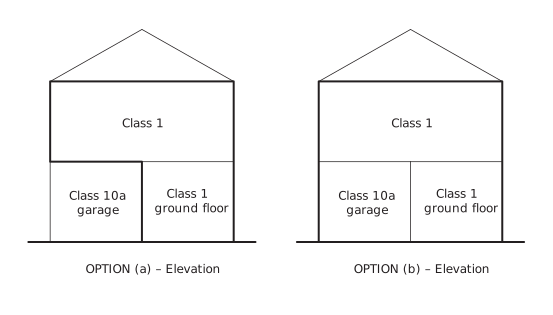
The attachment of a Class 10a building, such as a garage, glasshouse, solarium, pool enclosure or the like should not compromise the thermal performance of the Class 1 building. In addition, the Class 10a building may be insulated and so assist the Class 1 building achieve the required thermal performance. Explanatory Figure NT 13.2.6 below depicts examples of a Class 1 building with an attached Class 10a garage.
Insert NT figure (13.2.6 (explanatory)) as follows:
NT Figure 13.2.6 (explanatory): Attached Class 10a building examples
Figure Notes
In (a), the thermal performance required for the Class 1 building may be achieved by the outside walls and floor of the Class 10a garage.
In (b), the thermal performance required for the Class 1 building may be achieved by the walls and floor of the Class 1 building as if the Class 10a garage is an under floor space with an enclosed perimeter.